Monday, August 30, 2010

Brilliant Color Dotting the Earthy Brown


Rebecca came home today. Well, not "home", home, as she's been sleeping in her own bed for a few days now, but she came back to our program, back into the welcome embrace of those who have run by her side for the last four years and have been cheering and praying for her healing over the last three weeks.

She came wrapped in a surprise and burst forth in a mix of delighted shock and smiles of joy. It was quite a moment.

Accompanied by her Mom, Dad, brother and Coaches Clendenen and Griesinger, she "interrupted" our Monday meeting at the start of practice. It was a most welcome interruption!

Oh my, what a grand occassion. Three weeks to the day since CBU's terrible and tragic accident ... three weeks after traumatic injuries ... three weeks of intensive care in Reno, Rebecca walked in Riverside and right back into our lives.

We shared in the joy of seeing our loved one again. We marveled at her pace, her determination, her sheer grit. Those of us privy to the accident details could only stand in awe at what we beheld ... a lovely young woman, walking now with purpose, planning to run again and fulfill her mission in life.

My mind was taken back to the stunned silence of the night three weeks ago today when, in the dark of a Mammoth midnight, we got the news of the accident. A numbness descended over our camp the next morning. We wrestled with the fact of fear, of uncertainty ... the confusion of "what next?" We ran that morning ... it was a trudge for some ... but we ran up the big hill called Dead Man's Pass, our minds fixed on pain, real and imagined. We ran to the top, soaked in the view from 10,200 feet under a canopy of blue. Wild flowers painted the ground in yellow and purple, adding a festive hue to the earthy browns. We heard the muffled symphony of creation but it was hard to catch the tune. It was that kind of moment. A big, gigantic run, a celebratory tradition of our week in Mammoth, deadened by our sorrow. It was hard to let it rip and feel the joy.

In Riverside today, Rebecca shared time and words with us, her presence pushing our practice time back by ... well who cares. We ultimately did run, but there was no magnificent climb to ascend, no grand vista to greet us, just a mundane route we've done many times, checkered by suburban spreads painted in terrocotta shades of earth.

Yet Rebecca's visit, at least for this runner, did something to that routine. Energized by the gift of life, reminded of it's fragility, this "normal" run took on new colors and new meaning. How grateful I am for Rebecca's life, for the opportunity to have shared the road with her for four years, to taste the struggles and joys of sports and life together. I saw that idea in clear, vibrant colors as I ran through the housing maze of Orangecrest.

Today Rebecca came back to us, packaged as a gift, a new treasure of life. From the shadows of a great crash, her life and smile and radiant beauty reminds us of the brilliant colors that dot the earthy browns and greys of life. David Crowder puts it well: "A certain sign of grace is this, out of the broken earth, flowers come up..."

For those six miles today, the normal took on new beauty, a freshness and splendor not unlike the rooftop of Mammoth.

Thank you Rebecca, for inspiring us yet again. Oh, and welcome home!

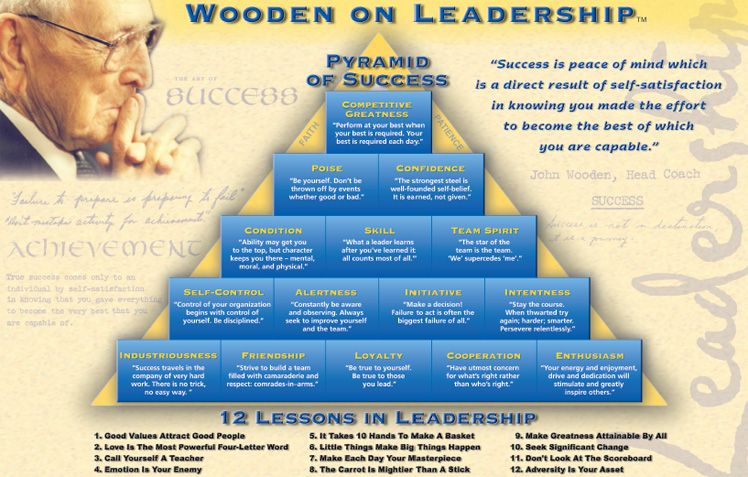
Wooden's Secret of Success - Alertness


When you typically think of being alert, goal setting does not come in to play. We need to stay alert while driving, be aware of our surroundings when we go from place to place, and work to remain focused and sometimes awake doing everyday tasks. Sometimes we work through our daily tasks without even thinking about them. We go to class, say hi as a formality to people we may not really know and finish our days not really thinking about whether we moved closer to any goal we had set for ourselves.

On John Wooden’s Pyramid of Success, his seventh secret is “alertness” which he tells us to “Be observing constantly. Stay open-minded. Be eager to learn and improve.” When you connect this to last week’s secret of self-control and ambition, we see how the block of alertness does affect our goals. Without goals, we won’t remain alert while completing practice, studying for a test, pursuing a job or living our best life.

Psychologically it makes sense. Let’s say you really want to save money to take a trip to Disneyland or to a great destination. You will start to become alert to what it takes to save money. You will become aware of every money earning possibility that confronts you rather than not being alert to them if you didn’t have to earn money. When you set the goal of earning a certain amount of money you become alert to the opportunities it takes to achieve that goal. On the opposite side if you only focus on the negative- the what if’s, the fears, the bad things that have happened in the past, we have turned our attention from our goal to one of defeat before we have done anything. You do this when you race or confront a hard practice. You become completely alert to all the bad feelings you could have, the pain you may feel, and disappointment of possibly not doing your best. Instead of being alert to our goal and outcome we focus on being alert to possible negative results.

In our hectic, busy and cell-phone filled lives, we may feel as if we are always alert because we are always on the go and connected to everyone and everything. Rather, the opposite is true. With our heads buried behind computer screens and phones, we may miss half the people that cross our paths. We may miss beautiful scenery or the opportunity for an important face to face conversation with a loved one or even someone new. It is often difficult to quiet our minds and to remain still, but this is when the most alertness occurs. We become completely present with our thoughts, where their taking us and what we want from our lives. Through quiet observations of ourselves and others, we become increasingly alert and sensitive to other’s needs as well as our own.

As a coach and teacher, I must remain sensitive to each student and athlete’s method of motivation and inspiration. I must become a better observer to their needs. Whereas one person might like a daily dose of questions and answers another might like a random comment once a week. In asking better questions and working on truly listening, we actually grow as a person, a leader and in our alertness. Whereas we may want nothing but answers, it’s our questions that help us grow.

Written by Coach Clendenen


Wooden's Secret of Success - Self Control

This season we are focusing weekly on the John Wooden's famous Pyramid of Success. Our aim is to instill in our athletes the character traits of team work and the building blocks of competitive success. While in Mammoth, our discussions focused on the base level of the pyramid, and now that the season has started we're working our way to the top and a block a week will be our aim.

These short articles are being written each week by Coach Clendenen:

Secret #6 in John Wooden’s Pyramid of Success is “Self Control”. We show self-control each day as we avoid eating too much, spending too much money or making choices that don’t help us become the best person that we can be. Wooden defines self-control by saying we must “practice self discipline and keep emotions under control. Good judgment and common sense are essential”.

Building on the base blocks of hard work, enthusiasm and team play, Wooden links the block of self-control with the trait of “ambition”- an ambition for NOBLE goals. When we combine the two, we see how they must go hand-in-hand for without having a goal, any goal, there would be no real need to practice self-control of any sort.

At first glance it may appear that self-control is what we need to discipline ourselves away from the playing field. We have goals to race better, improve our times, to rise to the occasion and therefore we must eat right, stay focused, go to bed early, and make sacrifices for the sake of our sport. Ultimately these are important, especially as teenagers who are surrounded by so many out of control people. Through self-control you will indeed become a better runner. You will feel strong; self confident in knowing you have done the right things to help you become a better athlete. More important to all of this however is how self-control will help you become a stronger individual and one that can truly set, create and achieve a noble goal.

Wooden says that “Success is peace of mind, which is the direct result of self-satisfaction in knowing you’ve done the best of which you are capable.” Self-control seems to be the clear stepping stone to achieving the kind of success that leads to the peace of mind that you have indeed done the best of which you are capable. How many times have we finished a race, practice, test, assignment, conversation with a friend or loved one and said, “I could have done better. I can be better.” We are full of regrets. We don’t race, act, believe or speak nobly. With clearly defined goals, ambition to become bigger than we have ever been before, we must practice self-control in all paths of life. Your actions, thoughts, values must become natural and not forced. They must be applied to your life and your life only for we are all faced with different circumstances and must rise above them. It is our head that must rest soundly on the pillow at night knowing we have peace of mind in being the best person we can be.

In the book Beyond Success, based on Wooden’s pyramid, the author Brian D. Biro, shares the story of Jackie Robinson, an obvious candidate for someone that epitomized self-control. Robinson, is a baseball hero who broke the color barrier when he became the first African American to play in Major League Baseball in 1947. Robinson, who played for the Brooklyn Dodgers, was obviously a success athletically, helping his team win the World Series six times, winning the National League’s MVP and playing on six All Star teams. Robinson clearly had to show self-control as a professional athlete, but in an era where people spit on him in public, mocked him on the field when he was up to bat and forced him to do things separately from his teammates while they were in public, he had to show self control in even more profound ways. Robinson was known to never complain, never fight back and never put anyone down. He was there when his teammates needed encouragement and made it a point to reach out his hand to a fellow opponent. He is known for saying that it did not matter if people liked him or not, the only thing that mattered was that they respected him.

Self-control knows that you must treat your own life with the sort of respect you hope to earn from others. It is a knowing that you are rising above the value that sometimes society places on us. It means living a life nobly to better those around you and to live your life in a way that helps you realize you are becoming the person that people can recognize as a goal-setter, a leader and a team player that stands up for what is right even when others may disagree. It is living your best life. This goes back to the groundwork for the pyramid. In order to be a good teammate you need to not strive to be like someone else on the team and compare yourself to others, but to make yourself a better person for the sake of the team.

As long as we are breathing, living and enjoying all the great opportunities we are presented with each day, we must strive to be better. We will be faced with adversity, obstacles and difficulties. We will have to help others overcome their own personal tragedies, defeats and struggles. We will face circumstances that we just can’t control- but we will want to control anyway. It will make us sad, mad, scared, and feel defeated. It is our amazing ability as humans, however to rise above these challenges and show great self-control because we respect the gifts and lives we have been given and to act with great ambition for the next opportunity to succeed in practice, in the classroom, in a race, in your home and in your community.

Friday, August 13, 2010

Big Run, Big Game, Big Names

Yesterday we had a fun, challenging, and busy day. The morning started with our traditional "Big Smokey" long run, with the boys getting a full half-marathon in while most of the girls ran a tick over 11 miles. All finished well and it was a successful run.

After some time to rest and recover, we headed over to Shady Rest Park for the afternoon. A second-annual game of kick ball commenced, with typical hilarity. The Meecen (don't ask, it's a word that just came to be, born from men in Mammoth) were victorious, in large part to Dustin Means' cannon of a right leg, the "rookie" launched two long balls and circled the bases in dizzying fashion. He won the Player of the Game award, a title so prestigious that the game ball goes to the winner. This year's sphere was a baby blue bouncer with Star Wars figures painted on it. Sweet stuff, that.

We were treated to a delicious BBQ of burgers and dogs by Coach Peirce and the "Lords of the Grill", Mr. Andy Schupp and Mr. Mike Ritter who cooked 'em up to order. It was goooood.

The night was topped off with a presentation of Q-and-A by members of the Mammoth Track Club, a group of professional runners who live and train in the altitude of Mammoth Lakes. Among the six who spoke were Ryan Hall and Deena Kastor. Both are the leading marathoners from the United States, and Ryan ranks as one of the best in the world. Deena was the bronze medalist in the 2004 Olympic Games in Athens, and was poised for an even higher finish in 2008 before her foot broke at mile three of the race. These and several others shared candidly and with humor the lessons they've learned along the way. This, after serving watermellon to the couple-hundred high school runners who came to listen. There was no fee for their knowledge.

Following the presentation, the pros mingled with the kids posing for photos and smiling gamely. Truly a unique aspect of our sport is the humility of it's very best! Good times.

The boys with Ryan Hall


Trevor Berney makes the catch


The girls with Ryan Hall


Girls, girls, girls!


MVP of the game, Dustin Means!

An Uphill Climb


We ran and in some ways are still are running with heavy hearts on the news of CBU's tragic accident and the traumatic injuries to one of our beloved alums, Rebecca Trupp. While the prognosis as of this writing is hopeful, she still has a long way to go and will be working hard to recover in the coming weeks and months.

The news hit us hard Tuesday morning and we were somewhat numb as to what to do. After some time of talking and crying we decided to go ahead and do the planned run up Deadman's Pass. Some said, "It would be a tribute to Rebecca."

Knowing some would struggle with the emotions and carry the weight of sadness and fear, we made our way up the hill in whatever fashion we could muster. Some ran, some walk, some did a little of both. Some cried.

As I struggled up the mighty grade, I thought of Rebecca and how she was such a fighter, especially on hills. During her years running with us, she was just so tough on hills, she was such a fighter. As my heart rate redlined and my quads ached, I thought of her. I thought of how I never once witnessed her giving up. I kept going. So too did her former teammates and those few among us who never had the opportunity to know her and be inspired by her.

Our usual celebratory spirit at the summit was naturally muted. We enjoyed the view. The brisk wind whipped at our dampened bodies. We waited for the last to arrive, took photos and headed back down.

I couldn't help but think of the parallels this run had to what perhaps Rebecca is now going through. She's on an uphill climb of recovery. There will be pain. Patience and endurance will be critically important.

Along the way, she'll need our cheers, our support, good words well timed. Just as we urged each other on to the top of Deadman's Pass Tuesday morning. Those words of encouragement ... "You can do it, keep going" will be what will sustain Rebecca in the coming weeks.

Some wonder why we annually choose to tackle such a tough run. You could say it's because it's hard. But really its because of what awaits us at the top. The view is simply spectacular, and given the toll such vistas require, they are all the sweeter.

I can only imagine that such views await Rebecca when the healing process is complete. I hope so. Until then, she will trudge onward, one step at a time, progress made.

You and I must cheer her on. We must not fail.

Monday, August 9, 2010

The Passage of Time


Time is an interesting concept. It moves almost without notice. It doesn't need an engine. It's measure by light, shadows, wrinkles and watches. It creeps up on us. It flies by. Moments can seem frozen in time, and then there are times when we remark, "my, where has the time gone?"

We marked the passage of time last night, as two of our own celebrated birthdays. Hanna (17) and Sabrina, (14). One is entering the last year of high school, the other just entering it. Like bookends, they are beginning and end.

So it was a moment in time worth celebrating. Cupcakes with an abundance of frosting were handed out and an off-key rousing rendition of "Happy Birthday" was sung at the top of our lungs. Given the altitude, we were a bit winded by the time the last note was sung off-key.

In the morning we made the most of our time with a run around Convict Lake, a truly inspiring place of serenity and beauty. We stopped along the footbridge at the western edge of the lake to soak in the artistry of creation and enjoy the time we had.

An easy pace back down the road brought us to the end of an hour spent running along trails, around a lake, under the heaven of blue.

It was a good time. What did you do with your time today?


Sunday, August 8, 2010

Day One on Day Two


We've had a good day today, with great weather and sunshine, a lot of sumptious food and about 11 miles put in our collective banks.

As I wrote yesterday, our traditional first-afternoon run along the scenic Mammoth Rock Trail had to be scrapped due to potential thunderstorms. So, we did Day One on Day Two.

It was beautiful. We're still acclimating to the altitude, so we kept the pace well within our comfort zones, allowing time to laugh and look. The view along the hillside trail is truly spectacular!

Saturday, August 7, 2010

The Eagle Has Landed, We're Here!

While the weather down South has been pleasantly delightful all summer, we were greeted upon arrival in Mammoth to actually cool temperatures and a strong breeze! Our drive north was a breeze too, thankfully, and we've all made it safely through our first run.

Tradition had to be scrapped however. For 10 years, our traditional first run has been to take the very scenic Mammoth Rock Trail that overlooks the village and the valley, the White Mountain range off in the distance.

Some ominous storm clouds have been brewing over the Sierra's since we arrived, and since they seem to have congregated for a meeting over the trail, we decided to avoid potential lightening, and opted for an easy run through town. True to Mammoth form, we spotted no less than four other high school teams getting their run in as well. We'll get the Mammoth Rock trail in tomorrow evening.

So it's off to a good start. Ham and baked potatoes are cooking up and dinner's callin'!

Wednesday, August 4, 2010

Why Hills?


In light of the hill training we've been doing of late, I thought this short article by one of America's top coaches could be helpful explaining the what and why of hills in a training regimen.

"So why do we add in hill training? Hill training – either as continuous uphill runs or as hill intervals accomplish a lot in a short amount of time. The hill itself will provide you with great resistance training as you run. If the incline is steep enough then you will recruit many more muscle fibers over the course of the workout. Your hips and glutes work over-time when you are climbing over 2000 ft of elevation in one run.

With time and repetition you will get physically stronger as well as run faster once you hit level ground. Hills are also a great way to improve your running mechanics. Since the energy demand to climb a hill is that much greater than running on a flat surface you will learn how to use the right muscles to get you to the top. This workout has a way of getting rid of what isn’t working in a hurry.

In addition, hills provide you with the aerobic training that you need, but with much less pounding then when running on flat or downhill surfaces. Since you are always going up there will be less joint stress and eccentric muscle overload and this means that you can add in miles on hills without feeling like you ran a marathon in training.

Finally, hills are great for teaching mental tenacity and patience. If you go full steam into a hill you will probably get knocked over quick. A few more attempts like that and you will see that the prudent way to make it to the top is the steady approach. Conquering hills is much like conquering a marathon. The wise runner is the patient runner. Don’t give up if your first attempt goes south. Take the tortoise over the hare approach here and you will see a steady improvement that will bring tremendous dividends once you hit the streets. Running on a flat surface will feel like you are not working hard at all and then you can just watch the miles will fly by."

Monday, August 2, 2010

Commitment


Ever thought about what it takes to be successful in running? I bet your mind goes pretty quick to the things like "talent" or "ability". While those are part of the equation, I've been coaching long enough (started in 1989) to have seen plenty of talented runners who weren't very successful. Their ability didn't get them very far.

The reasons for those detours are numerous, but so often it's simply because they lacked commitment. To neglect commitment in running is to invite an early end to running. "Uncommitted runner" is an oxymoron.

The problem is that in our society, studies are showing that a lack of commitment is becoming the norm. It's now acceptable, cache. Just two years ago, more than half of people ages 20-24 had been at the current job for less than a year. Young Americans are marrying later in life than at any time in our history.

The obituary of commitment comes with the collateral damage to community. While we exalt a commitment to ourselves, narcissism (an obsession with what we think will make ourselves happy) stands in the way of developing a team, of nuturing the collective good. All of the foundations of a healthy society crumble with the religion of self-focus. Commitment is at the core of all human relations, and it is the essence of great teams.

So how does this apply to us? Well, it begs a question: How committed are you? What kind of determination have made to contribute in a committed way to the well being of this community we call King Cross Country?

More specifically:
How committed are you to your teammates?
How committed are you to improving?
How committed are you to serving others?
How committed are you to listening?
How committed are you to having a positive attitude?
How committed are you to us?

The irony in all this, is that our self-absorbed society has abandoned the principles of commitment in search of personal fufillment and happiness. Studies show that we are among the nations of the world, one of the least content, least happy?

Why? Because to gain more life, you have to give more of yourself away. Without a commitment to others, our individual lives are empty and barren.

I challenge you to die to yourself this season and find the life that comes from living for others. Start with a teammate, then two, then three.

If all of us do this, we'll have the most successful season we could possible have.

Thursday, July 22, 2010

Selfishness


I was thinking on the run this morning. I do that on occassion. It's how I role.

What I was thinking about midway through the run -- and consequently mid way through the series of hills we were taking on -- was how easy it would be to give in to the discomfort and pain. How very simple it would be to just slow down and make it all go away...

By mile 5, most of the runners I could see were singletons, the groupings that formed early had evaporated like fog in sun. Hills have a way of doing that.

So there in mid-hill, alone, I'm sure the temptation to slow down and take an easier pace to the peak must have tempted some of you. Right?

Well my next thought went to the team, and it dawned on me that in a team sport like ours, every mile run well, helps the team. Every mile run too slowly hurts the team. It's easy in the midst of a workout where you might be splintered from a group to get selfish and think only of how much you hurt, how much "faster" everyone else is and order up some cupcakes with extra frosting for the little pity party you're holding in your mind.

"Cross country is an individual sport" say the uneducated. Far from it, yet in the midst of training (and suffering) we can convince ourselves that the pathetic pace we're holding, or the bail we just took on the longer route, will only affect ourselves.

It will ... but it will also affect your team.

How? Because your failure to improve makes us less competitive. Because your cutting a workout short may "convince" someone else to go with you. Now we're two people down. On the reverse, when you run hard, you inspire others to do so as well. We get better as you get better.

Selfishness. It's tempting, it's even celebrated in our culture. It's also the worst thing for a team.

As the days stretch out into weeks, I challenge you to conquer your selfishness.

Friday, July 16, 2010

Butterflies


Well on Monday, we'll be at another starting line. This line represents the beginning of our 12th season as King Cross Country.

I've got a few butterflies. I'll be real.

But are butteflies bad? I've had an athlete or two over the years mention to me before a race that they've got butterflies. They say it like they're confessing sin.

While butterflies can create anxiety and upset your stomach and can even rob you of a good race on occassion, they really aren't anything to be ashamed of. They represent something. Something good.

Butterlfies say you care. They say you want -- really want -- a good outcome to what's lying ahead. They say you recognize the drama of sport. They say you want to do your best and can't stomach the thought of doing less than that.

So I'll admit, as I look at the starting line of next Monday morning, I've got a few butterflies fluttering.

I want this season to be better than last ... which is asking a lot.
I want improvement to happen ... in me.
I want to find out how we'll do in league and in CIF ... always tough challenges.
I want us -- you runners and we coaches -- to do our best ... all season long.

So bring the starting line, butterflies and all! Let's get it going!

Tuesday, January 26, 2010

Puddle Run!

For those of you who got your run done in the rain today, this is for you!

Friday, January 8, 2010

What do the Great Runners Have in Common?

In this video of The University of Michigan's coach Ron Warhurst, Warhurst discusses what all of the great runners have in common, and he adds some interesting insights into the art of racing, how great teams and great runners approach the race.

Track and Field Videos on Flotrack

Coming Back after a Bad Race (or two!)

Ever have a bad race? What about a bad season? Here's a three minute video from the coach of The University of Michigan in which he gives good advice on how to "move on" successfully after a less than desired performance.

Check it out!

Track and Field Videos on Flotrack

Tuesday, December 15, 2009

Dealing With Setbacks

Check out this short video from the elite Nike athletes as they discuss how they've dealt with setbacks in their careers. This was one of the festivities of NXN that Lane was a part of! Very cool stuff!

Monday, December 7, 2009

Animoto.com

Friday, November 20, 2009

The Running Man


You really should read this story about Meb, the American who recently won the NY City Marathon. Very inspiring story!

When Meb Keflezighi finished the New York City Marathon in two hours, nine minutes and 15 seconds the morning after Halloween, he became the first American to win the race in 27 years. But some spectators apparently missed the three red letters on his chest as he burst through the tape. Keflezighi is only "technically American," argued CNBC sports writer Darren Rovell. He's "like a ringer who you hire to work a couple hours at your office so that you can win the executive softball league."

Though Mr. Rovell has since backtracked, nobody recalls similar comments about Alberto Salazar, the Cuban-born American who won in 1982. And if Meb's name was Joe Smith and he was born in England rather than Eritrea, few would have questioned his national identity.

When I meet Meb the morning after his appearance on the David Letterman show—almost as great as winning the race, he quips—he is unbothered by the debate raging on the Web about his American-ness. "What's the list of things you need to be an American?" he asks rhetorically. "You live here, you pay taxes, you live by the American way. I've been here for 22 years. I'm as American as you can get."

As for wearing the USA tank top: "What a beautiful day to wear it on. In New York, to win my first marathon in that jersey—it just gave me great pride."

Talking to the 5-foot-6-inch athlete as he is massaged, iced, stretched and bent by his physical therapist on the Upper West Side, I could easily forget that he is one of the fastest men in the world. Unlike so many other professional athletes—huge in ego and stature—Meb is modest in both.

Which is not to say the 34-year-old isn't thrilled about winning his first marathon. "My email is full, my texting is full, my voicemail is full," he tells me with an incredulous smile. "I was kind of late coming here because for the first time since I got to New York I went to the breakfast place at the Hilton. And it was nonstop: 'You're not leaving 'til I get this picture,' or 'I need your autograph.'"
Yet he's quick to add: "It's a big honor. With fame and with winning comes responsibility." Meb doesn't see the need to be a role model as a choice: "You have to. People are following you whether you like it or not."

It's almost too convenient to chalk up Meb's character to his upbringing. Nevertheless, like so many other immigrant success stories, understanding Meb's parents and their values is essential to understanding who he is. He puts it simply: "They molded me."

Born in 1975, Mebrahtom (his full name means "let there be light") grew up in an Eritrean village with no electricity and no running water. Besides poverty, Meb's parents, Russom and Awetash, feared for their family's safety because of Russom's involvement with the Eritrean Liberation Movement and because of the ongoing war with Ethiopia. Meb's father decided to flee. "He walked all the way"—60 miles—to Sudan, Meb says. Russom eventually made his way to Milan, Italy, where he worked to raise the money to bring his family out of East Africa.

On Oct. 21, 1987, a date that rolls off Meb's tongue, the family immigrated to San Diego as refugees with the help of the Red Cross and the sponsorship of Meb's half-sister, Ruth. "Dad used to wake up at 4 a.m. so we could learn English," Meb says. "He worked as a taxi driver and worked in restaurants to be able to feed the family."

Meb adds, "You start on the bottom, work hard, and your dreams will come true—and that's what happened. We have a very successful family because my parents always emphasized using the opportunity you have to the maximum: 'There are a lot of people that don't have this opportunity, so make sure you use it.' That stuck in our head."
They stressed school to their 11 children. "Sports was not in our blood or in our family," Meb says. "So it was 'Do what you can and work hard. Your teachers are your parents when you are at school. They want the best for you, so make sure you listen to them."

Meb's oldest brother, Fitsum, was the trailblazer. He started ninth grade not knowing a word of English. By the end of the year, he won the top academic prize. The Keflezighis still have the tiny trophy 22 years later.

That ethic was key to Meb's success. "When I started running for the first time—seventh grade—I wanted to get that A, just like my parents taught me."
Meb had never run in his native country and had no concept of running as a sport. But his family's San Diego apartment was down the road from Morley Field where the national Foot Locker high school championship is held. "When I saw them running, the high school champions, I was like 'What are these crazy people running for?' They're not chasing a soccer ball or anything else."

Meb's two older brothers decided to take up the sport, he says, and "I just followed in their footsteps." At 12, he ran his first mile. He clocked in at five minutes and 20 seconds—with no training. Dick Lord, the PE teacher at Roosevelt Junior High, called up the high school coach on the spot: "Hey, we got an Olympian here."
Ron Tabb, who ran the marathon in 2:09 in 1983, saw similar potential in the young runner. Meb recalls Mr. Tabb seeing him practice in 1992. "He said: 'You're going to be a great marathoner and make the Olympic team in 2000 and be a medalist in 2004,'" Meb remembers. "So a lot of people did read my future."

By his senior year in high school, he says, "I ended up being one of those crazy guys running in the national championships." From San Diego High School, he went off to UCLA. Bob Larsen, who has remained his coach until today, offered the straight-A state champion a full ride. There he became a four time NCAA champion. And in 1998, the year he graduated, he became a citizen. Meb traces his success back to those years. "It goes back to high school—you try to be the best high schooler there is, and then to be the best collegiate runner you can be." Unlike team sports, "with running, it's just you and what you decide to get out of it."

If Meb sounds old school, that's because he is. His message for young people is simple: "Life is precious. Do something that is optimistic—that is good for society. Don't sit on the couch." His heroes, other than the list of American long-distance runners he rattles off (Jim Ryun, Steve Prefontaine, Steve Scott, Eamonn Coghlan, Paul Tergat), are Jackie Robinson and his parents. About himself, he says: "My God-given talent was discovering when I could run 5:20. Not everyone can run 5:20 . . . I was definitely gifted, but I have to work hard."

His determined training has helped him defy people's expectations. At the 2004 Olympics in Athens, Meb was ranked 39th out of 101 runners. He walked away with the silver medal with high hopes for the Beijing Olympics.

The Olympic trials in 2007 brought no such victory. Not only did Meb not make the Beijing team—he finished eighth—he fractured his hip during the race. Then there was the terrible tragedy of Ryan Shay's death. The rising marathon star and Meb's close friend suffered a massive heart attack during the race. During this year's marathon, Meb crossed himself in the spot where Shay went down.

"The darkest part of my running career was last year," he says. "I could have easily hung it up." Was he tempted to retire, I ask? "Oh yea. I'm not going to say I wasn't. I couldn't walk—I was crawling like a 10-month-old baby," Meb says about his hip fracture.

Recovering from the injury took a year and a half of intensive therapy and "hard work." But "hard prayer" was also crucial for Meb, who, like his parents, is a deeply religious Christian. Though his training schedule doesn't always allow him to make it to church every Sunday, he makes time for prayer "every day before I go to sleep and every day before I get up." He also uses the 15 minutes he spends in the ice bath for reflection: "Every day in the ice bath is my God time," he says.
As he healed from his injury "I really got to know who my friends are—who's got my back." One of them is Bob Larsen, his coach for 18 years. "It's like a marriage," Meb says about their relationship. He's "a great mentor."

Meb lives and trains in Mammoth Lakes, Calif., a hub for distance runners because of the high altitude. Though the distance varies from day to day, there is no escaping the reality that marathon training is every day, approximately 130 miles a week. Sundays, Meb runs at least 20 miles, sometimes up to 27 or 28 miles. Thursday is a recovery day, "which means you run just 10 miles in the morning and then a few in the afternoon." Fridays are a "simulation of what the marathon will be like: He runs "race pace or faster anywhere from eight to 15 miles." He also bikes and lifts weights, though he has to be careful not to build up too much muscle. "For 26.2 miles, you want to be a lean, mean machine."

"During practice," he says, "probably 90% is physical and 10% is mental. When it comes to race day, it switches because you know your body is ready and then you have to use your head to be able to perform."

To pump him up for this year's race, Mr. Larsen encouraged Meb to pretend he was "going on a long run with his buddies. Relax for the first hour and get to work after that." Marathons, Meb says, "are about patience and even pace."

He followed that strategy on Nov. 1, sticking with the elite pack, even allowing himself to drift a few feet behind the front runner. The wind, he says, was the hardest part of the race. But Meb realized he was in a fantastic spot as he ran up Fifth Avenue. "With two miles to go, I knew I had it in the bank," he says. As he entered Central Park at 90th Street, he saw his opening and pulled ahead of four-time Boston Marathon champ Robert Cheruiyot of Kenya.

British marathon champion Paula Radcliffe has said that she sometimes counts her steps during marathons—300 steps in a mile. "I do not count my steps at all," says Meb. "I take in what the crowd is doing—screaming Go USA, or Go Meb! The crowd is always going to get you through the good and the bad." And the New York crowd, he says, is simply "the best that there is."

As Meb ran through the finish line to screaming crowds, he crossed himself and kissed the ground. Seeing his wife, Yordanos, put him over the edge.

"When she saw me—I can't put it into words," he says. "Here's a guy that couldn't walk, that couldn't turn in bed because of my hip fracture . . . so when we saw each other we just broke down in tears." Meb credits his wife, who is also a native of Eritrea, as critical to his ability to perform. "She is seven months pregnant, we have two kids, and I'm the one who's taking a nap. She's very unselfish. She's been a big part of this success." When he met her, right before the 2004 Olympic trials, "we just clicked about God and family and perseverance."

As he allows his body to recover—with ice baths, eating the right protein, and physical therapy—he is focused on his next races. The 2012 Olympics are a clear goal. Many are speculating that he might go for a win in Boston this April. "I really think I can do it. I've done it once and I finished third. Now I know the course and I'm healthy." How much time can he shave off? "The body can do amazing things. I still believe my best times are ahead of me."

Meanwhile, he's savoring his win. And next week, he'll be back to New York, this time for the Macy's Thanksgiving Day Parade. Meb will be riding with Miss America—on the Statue of Liberty float.

Ms. Weiss is an assistant editorial features editor at the Journal.

Monday, November 9, 2009

Distractions


A crazy thing happened yesterday in Fairmont Park. No, not what you're thinking. I was running in the Mission Inn Half Marathon, at just past a mile, when all of a sudden a phone rings. I can honestly say that as it was ringing, my mind was all, "no, that's not a phone ringing. We're in the middle of a race. Phones don't go off in races."

I was in a pack of maybe 8 guys, cruising along at about 6:30 per mile, and one of them makes a surge to the front of the group -- like he wants some privacy or something -- pulls out his cell phone from I-don't-know-where and says, "Hello?"

Hello? What, are you kidding me?

Either I'm getting a lot slower, or this is just plain redonkulous. The guy proceeds to have a conversation with whomever, finally yelling into the phone, "I can't talk right now, I'm in the middle of a half marathon!" Well, duh, what are you carrying your phone for in the first place?

No joke here, but on my way back after the turn-around, I saw a woman carrying on a conversation on her cell phone. Goodness. What's the world coming to.

All this reminded me of how easy it is to get distracted from the moment. Most folks who run half marathons have spent a fair amount of time preparing for race day. 13.1 miles is not exactly a distance most runners can just role out of bed and go do. Because of that, I'd assume, one would want to put the entirety of their focus and concentration on the task at hand. Eliminating distractions, like, say a cell phone in your shorts(!) would be a given, wouldn't it? Again, I'm just assuming here...

What are you focused on? Anything? What have you spent a lot of time preparing for? What are you willing to give up to achieve your goal? Or are you too distracted by the tyranny of options, the din of being busy that you can't zero in on what is really important?

One of the consequences of a culture that thinks "you can have it all" is that we fail to see that "having it all" can be a major distraction from "having what's good." As you pursue a major goal -- such as a berth at CIF Finals this weekend -- I challenge you to think about what (or who) may be your greatest distraction from achieving that goal and kindly put it "on hold" for the time being. Trust me, it will be waiting for you after success has been accomplished.

Being able to talk on one's cell phone while in the middle of a competitive half marathon may be a modern marvel, but it certainly isn't a way to finish the race with any semblance of athletic dignity.

Hey buddy, the clue phone is ringing, and it's for you!

Sunday, November 1, 2009

Going the Distance - Rebecca Asplund


Like a ship slowly moving out from the safety of a harbor, she cut her lines and said goodbye. I was surprised when I heard the news, knowing what I did about the years Rebecca had devoted to club softball before arriving at King High. I figured she'd do both sports, so it was with a couple of raised eyebrows I countenanced these words:

"I've quit softball."

Her conversion was quick and with conviction. By mid-October of her freshmen year Rebecca decided she had found her love and the love was returned. Running would be her passion and joy.

We watched with equal measures of joy and admiration as this young rookie dove into the sport headfirst, learning and growing with an ambition that seemed to say "I'm going to make up for lost time."

She ran varsity that first year. And the second year. And ... well then came her third season. Beset by a host of physical issues that robbed her of strength and endurance, she suffered through a season she wouldn't want to wish on her worst enemies. The days were dark and long and the season seemed to be one protracted bludgeoning of hope.

But somehow she managed to not give up. Maybe because her personality is anchored to grace and peace. Anyone who has spent any time with her is quickly attracted to her dimpled smile, joyful laugh and eyes that twinkle like stars in a blackened sky. If it is darkest before the dawn, then perhaps it was so that the light of faith could shine brighter than ever, glimmering a path of redemption and new birth on the seas of adversity.

Having weathered the gale of that horrendous year, she finds herself in the infant months of a new life, one brightened with the wisdom born only in trial and built on the realization that for every season in life, there is a new beginning.

Unmoored, she sails purposefully again, aiming at the open ocean of opportunity and trial. No telling where she'll end up, but this much I do know. Having learned to run by faith, not by sight, she's well-equipped to handle any tempest that lies in wait out there on the horizon.